 78fb78bdde
* perf: skip retrieval in scroll when no payload or vectors are requested

Every scroll variant went through SegmentsSearcher::retrieve to build its
records, even when neither payload nor vectors were asked for. That is a
has_point lookup per id per segment plus a version and id resolution per
hit, only to yield records holding nothing but the id. The universal query
API always scrolls this way and fetches payload separately afterwards.

Build the bare records from the ids directly in that case. The retrieve
could only have dropped ids deleted in between, which the update lock held
across the scroll rules out.

* perf: fetch payload and vectors in the leaf of plain query requests

A query without prefetches and without rescoring is served by a single
leaf search or scroll whose result is returned as is. The planner still
built that leaf without payload or vectors and filled them in afterwards
through SegmentsSearcher::retrieve, which resolves every result id in
every segment again: the same cost #10312 removed from the search API,
paid once more at the end of each query.

Let the leaf carry the requested payload and vectors instead, so the
segment attaches them to the results it already holds by offset, and
clear the root plan so the fill step is skipped. Prefetch leaves and
rescored roots (MMR) are unchanged. As with the search API, this fetches
payload for each segment's candidates rather than for the merged top
`limit` alone.

* Use new_empty function

* fix: fetch payload and vectors in scroll leaves only (#10384)

A search leaf hydrates every segment's local top-k before merging, so
`with_payload` there multiplies payload I/O by the segment count — the
regression #6279 fixed and `test_payload_io_read_is_within_limit[query]`
guards. Scroll leaves retrieve once for the merged page, so they keep
fetching directly; search leaves stay bare and the root plan retrieves
for the final result.


Claude-Session: https://claude.ai/code/session_01SUWh5PqUeSefrUqUwXxU3E

Co-authored-by: Claude Fable 5 <noreply@anthropic.com>

---------

Co-authored-by: Andrey Vasnetsov <andrey@vasnetsov.com>
Co-authored-by: Claude Fable 5 <noreply@anthropic.com>

Vector Search Engine for the next generation of AI applications






Qdrant (read: quadrant) is a vector similarity search engine and vector database. It provides a production-ready service with a convenient API to store, search, and manage points—vectors with an additional payload. Qdrant is tailored for extended filtering support, making it useful for all sorts of neural-network or semantic-based matching, faceted search, and other applications.
Qdrant is written in Rust 🦀, which makes it fast and reliable even under high load. See benchmarks.
With Qdrant, embeddings or neural network encoders can be turned into full-fledged applications for matching, searching, recommending, and much more!
Qdrant is also available as a fully managed Qdrant Cloud ⛅ including a free tier.
Quick Start • Agent Skills • Client Libraries • Demo Projects • Integrations • Contact
Getting Started
Agent Skills
Qdrant provides a collection of ready-to-use agent skills that bring Qdrant's vector search capabilities directly into your AI coding assistant. Install these skills to empower your agent in making critical engineering decisions for optimal vector search performance, such as quantization, sharding, tenant isolation, hybrid search, model migration, and more.
Client-Server
To experience the full power of Qdrant locally, run the container with this command:
docker run -p 6333:6333 qdrant/qdrant
Note that this starts an insecure deployment without authentication, open to all network interfaces. Please refer to secure your instance.
Now you can connect to the server with any client. For example, using Python:
from qdrant_client import QdrantClient

client = QdrantClient(url="http://localhost:6333")
Before deploying Qdrant to production, be sure to read our installation and security guides.
Clients
Qdrant offers the following client libraries to help you integrate it into your application stack:
- Official:
- Community:
Qdrant Edge
Qdrant Edge is a lightweight version of Qdrant designed for edge devices and resource-constrained environments. Unlike Qdrant Server, which uses a client-server architecture, Qdrant Edge runs inside the application process. Data is stored and queried locally and can be synchronized with a Qdrant server. It offers the same powerful vector search capabilities as the client-server version but with a smaller footprint, making it ideal for applications that require low latency and offline functionality.
To get started with Qdrant Edge from Python or Rust, initialize an instance of EdgeShard, which exposes methods to manage data, query it, and restore snapshots. For example:
from qdrant_edge import Distance, EdgeConfig, EdgeVectorParams, EdgeShard, Point, UpdateOperation

shard = EdgeShard.create("./shard", EdgeConfig(
    vectors={"my-vector": EdgeVectorParams(size=4, distance=Distance.Cosine)}
))
shard.update(UpdateOperation.upsert_points([
    Point(id=1, vector={"my-vector": [0.1, 0.2, 0.3, 0.4]}, payload={"color": "red"})
]))
Where Do I Go from Here?
- Quick Start Guide
- Detailed Documentation
- Take the Qdrant Essentials course
- Follow this tutorial to create a semantic search engine with Qdrant
Demo Projects
Discover Semantic Text Search 🔍
Unlock the power of semantic embeddings with Qdrant, transcending keyword-based search to find meaningful connections in short texts. Deploy a neural search in minutes using a pre-trained neural network, and experience the future of text search. Try it online!
Explore Similar Image Search - Food Discovery 🍕
There's more to discovery than text search, especially when it comes to food. People often choose meals based on appearance rather than descriptions and ingredients. Let Qdrant help your users find their next delicious meal using visual search, even if they don't know the dish's name. Check it out!
Master Extreme Classification - E-Commerce Product Categorization 📺
Enter the cutting-edge realm of extreme classification, an emerging machine learning field tackling multi-class and multi-label problems with millions of labels. Harness the potential of similarity learning models, and see how a pre-trained transformer model and Qdrant can revolutionize e-commerce product categorization. Play with it online!
API
REST
Qdrant provides a REST API with an OpenAPI 3.0 specification, enabling client generation for virtually any framework or programming language.
You can also download the raw OpenAPI definitions.
gRPC
For faster, production-tier searches, Qdrant also provides a gRPC interface.
Features
Dense, Sparse, and Multi Vector Search
Qdrant supports dense vectors for semantic similarity, sparse vectors for full-text search, and multivector search for objects with multiple embeddings or late interaction models like ColBERT.
Filtering on Payload
Attach any JSON payload to your vectors and filter on it using a rich set of conditions—keyword matching, full-text, numeric ranges, geo-locations, and more—combined with should, must, and must_not clauses.
Hybrid Search
Combine multiple vectors in a single query to get the best of semantic understanding and keyword precision, with results merged via configurable fusion strategies, such as Reciprocal Rank Fusion (RRF) and Distribution-Based Score Fusion (DBSF).
Vector Quantization and On-Disk Storage
Built-in quantization cuts RAM usage by up to 97% and lets you tune the trade-off between search speed and precision.
Distributed Deployment
Scale horizontally with sharding and replication, and update or resize collections with zero downtime.
Highlighted Features
- Faceting - aggregate search results by payload values.
- Recommendation - use positive and negative examples to find similar points.
- Discovery - constrain search to a specific region of the vector space.
- Search Relevance Tuning - tools for adjusting search results, such as Maximal Marginal Relevance (MMR) and the Relevance Feedback Query.
- Multitenancy - scalable partitioning of data for multi-user environments.
- Observability - comprehensive metrics, telemetry, and audit logging for monitoring and debugging.
- Query Planning and Payload Indexes - leverages stored payload information to optimize query execution strategy.
- SIMD Hardware Acceleration - utilizes modern CPU x86-x64 and Neon architectures to deliver better performance.
- GPU Support - for accelerated indexing, with support for NVIDIA and AMD GPUs.
- Async I/O - uses
io_uringto maximize disk throughput utilization even on network-attached storage. - Write-Ahead Logging - ensures data persistence with update confirmation, even during power outages.
Web UI
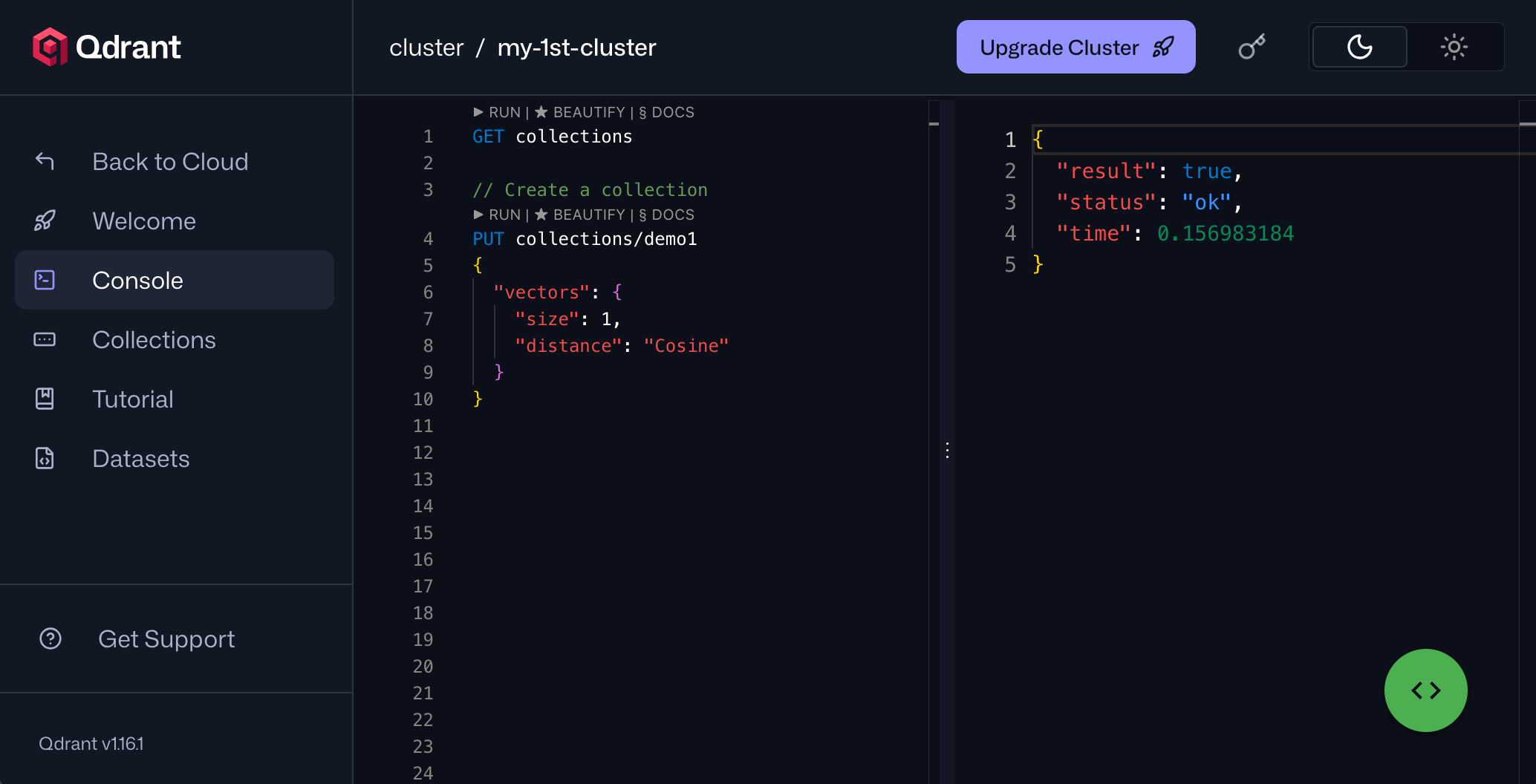
Web UI provides a visual way to interact with your data and monitor the health of your deployment. It enables you to explore your collections, manage data, interact with the REST API, and more.
Integrations
Qdrant integrates with the tools you're already using across every stage of your AI stack. You can connect to embedding providers, AI application frameworks, and data pipeline tools, as well as observability platforms for monitoring and tracing your vector search in production. No-code and low-code automation platforms are supported too. Refer to the Ecosystem page for the complete list.
Contributing
We are happy to receive your contributions! Before opening a pull request, please read our Contributing Guide.
Important
Our development branch is
dev, notmaster. Please fork the repo, branch fromdev, and open your pull request againstdev. PRs targetingmasterwill be asked to retarget.
Contacts
- Have questions? Join our Discord channel or mention @qdrant_engine on X
- Want to stay in touch with the latest releases? Subscribe to our Newsletters
- Looking for a managed cloud? Check pricing. Need something personalized? We're at info@qdrant.tech
License
Qdrant is licensed under the Apache License, Version 2.0. View a copy of the License file.